Feasibility Study of Exoskeleton Adoption in Hong Kong Construction Industry

KWOK Tsz Fung
郭梓峰
BSc (Hons) in Surveying
I am Billy Kwok, a final year surveying student who is passionate about new technologies, therefore I integrated my interest in this research. After studying surveying, I understand more about real estate from planning to demolition and make me want to contribute to this industry. Also, I hope the severe fatigue issue in the construction industry could be relieved when introducing new technologies, gradually improving occupational health and safety.
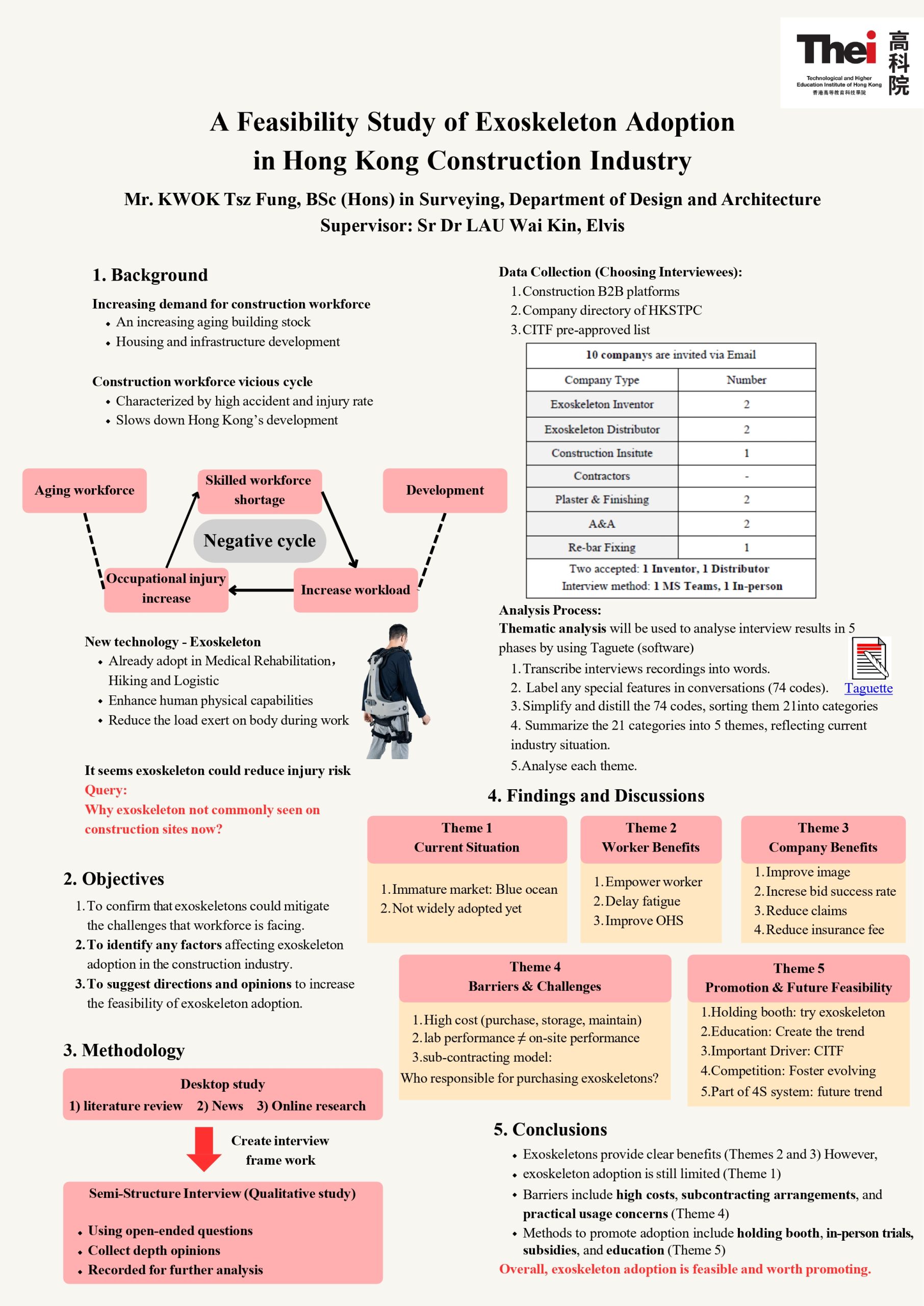
The Hong Kong construction industry faces different challenges, such as aging workforce, skilled labour shortages and high rates of occupational injury. Industrial exoskeleton is a promising solution to reduce physical strain, prevent injuries, and improve productivity. However, their adoption in Hong Kong remains limited.
This study aims to investigate the feasibility of adopting industrial exoskeletons in the Hong Kong construction industry. A qualitative research approach was adopted, by using semi-structured interviews with stakeholders in construction industry. There were 10 companies invited, including exoskeleton inventors, distributors, and contractors. Thematic analysis following Braun and Clarke’s (2006) six-phase framework was conducted using Taguette software on the data collected from two interviewees of exoskeleton inventor and a distributor.
It found that exoskeletons really brings benefits in reducing muscle burden, lowering injury risks, and enhancing work efficiency, but there are some barriers such as high initial costs, subcontracting issue. Both interviewees expressed optimism about future potential if these obstacles are addressed.
This study concludes that exoskeleton adoption is feasible in the long term but requires strong support from policymakers, industry bodies, and suppliers. Recommendations include pilot trials, government subsidies, and localised product development. The findings provide valuable insights for stakeholders and directions for future research.
Tutor: Elvis Lau